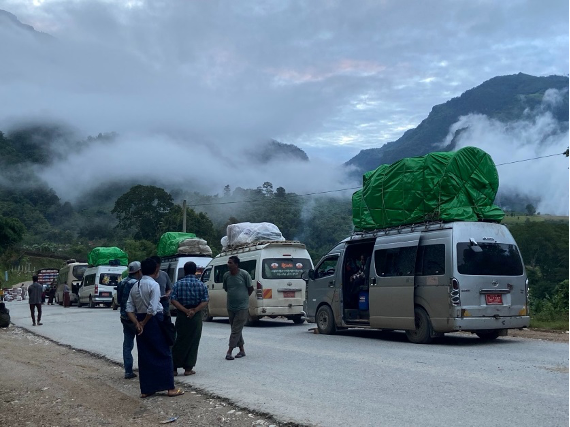
Armed groups have been competitively inspecting and arresting young people along routes from southern Shan State to the Thai border, according to travelers.
Since the last week of February, armed groups have stepped up checks and arrests of young people along the roads leading from southern Shan State to the Thai border, worrying young people and travelers.
“We don’t even dare to transport young people now. The armed groups wait for them almost every day in places like Pang Nga village. They let elderly people and others traveling for medical purposes pass. But young people no longer dare to travel. If they’re eligible for military service, it means they’ll be detained,” said one driver.
At the checkpoints along the road to the Thai-Myanmar border town of Tachileik, residency recommendation letters, National Registration Cards, and household registrations are checked more strictly than before. Children under the age of 18 aren’t allowed to travel without their parents, while those over 18 face arrest, according to one woman who has experienced this.
“We no longer see anyone traveling to Tachileik like we used to. Most no longer dare to go there, mainly for fear of being arrested. Some of those who want to return can’t do so either. They aren’t only afraid of the Shan soldiers, but also of the Burmese soldiers. If they’re taken away, no one knows where they’ll end up. They’re afraid of that,” said the woman.
After the ethnic armed groups competitively made statements on conscription, the drivers have run into difficulties as fewer youths and travelers are using their transport services, resulting in lower incomes and difficulty making ends meet.
“It’s more profitable when we have passengers. But now we can’t travel as freely as we used to. Six out of ten people who take this route go to Thailand. Even the drivers don’t dare to drive as much as they used to. If there are no passengers, it’s difficult for us, especially because fuel prices are rising. There is hardly anything left after loading and the return journey,” says one driver.
The checks and arrests are being carried out by the Shan State Progress Party/Shan State Army (SSPP/SSA), the Restoration Council of Shan State/Shan State Army (RCSS/SSA) and junta troops at places such as Pang Nga village junction, Kho Lam, Mongpan, Tar Kaw bridge and Keng Lun junction in Mongshu Township, according to those who have experienced this first-hand.
Calls to RCSS spokespersons Major Kham San and Colonel Sai Su for comment on the matter went unanswered.
On 19 February, the RCSS/SSA announced that it will confiscate the homes and property of Shan State residents if their families flee abroad.
The RCSS announced conscription policies requiring all ethnic nationals aged 18-45, both men and women, to perform military service during the armed conflict in Shan State, as well as land ownership policies so that everyone can fulfil their national duties.
Similarly, on 12 February, the SSPP announced restrictions and threatened to arrest locals from Kyethi Township attempting to travel to Thailand, including confiscating vehicles from drivers taking them across the border.
On 10 February, faced with setbacks on the battlefields, the military council said it would begin enforcing a conscription law for all eligible citizens.
The law stipulates that men between the aged 18-35 and women aged 18-27 can be called up. For those with professional qualifications, the age brackets are 18 to 45 for men and 18 to 35 for women.
Due to the junta’s conscription law, people are trying to flee to the nearby border areas.
Sent by Shan News.