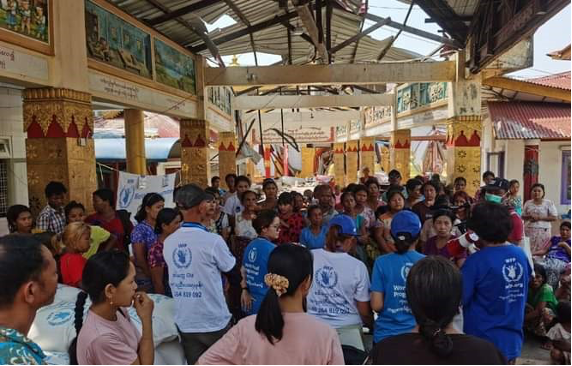
The Myanmar’s military council continues to suspend travel permits for humanitarian organizations to storm-hit Arakan State, the United Nations Office for the Coordination of Humanitarian Affairs (UNOCHA) announced on 19 June.
“This sudden decision has exacerbated the dire living conditions of the cyclone-affected population, as heavy rains and monsoon flooding have severely affected cyclone-affected areas,” UNOCHA said in a statement.
The Arakan State Administrative Council sent a letter to INGOs, NGOs and CSOs in western Myanmar state informing them to suspend travel indefinitely from 8 June.
There has been criticism of the suspension of travel by humanitarian aid groups at a time when the storm-stricken people of Arakan are in urgent need of assistance.
On 11 June, the state’s military council issued a statement allowing NGOs to carry out development work on the ground under previously issued permits, but aid workers say their freedom to travel on the ground remains restricted.
“I urge the State Administrative Council to urgently reconsider this decision and reinstate the distribution permit originally issued,” Ramanathan Balakrishnan, UN Resident Representative and Humanitarian Coordinator, said on 12 June.
NGOs in Arakan State have reportedly faced difficulties due to the military council’s delay in issuing travel permits for humanitarian aid distribution.
An NGO worker from Arakan State said, “They (the military council) had demanded from the beginning that aid groups apply for travel permits in accordance with the law. But we haven’t received the permission.”
UNOCHA said in a June 19 statement that approval of distribution and transport plans for the Cyclone Mocha response in Rakhine State and Chin State was pending.
A person helping people affected by the storm said the military council was violating the human rights of people in Arakan by restricting the right of humanitarian aid groups to travel.
“Those who call themselves ‘government’ should provide relief goods themselves. They should also facilitate the work of aid organizations. But now we have to steer clear of members of the military council when we go to rural areas to provide aid. Otherwise, there will either be trouble or we can be arrested,” he said.
Despite the humanitarian restrictions, aid agencies continue to provide vital assistance to cyclone-affected communities where they have been authorized to do so, UNOCHA said in its statement.
The Arakan Army (AA) announced that 1,547,761 people in Arakan State have been affected by Cyclone Mocha, which struck 14 May.
Residents reported that they had not received enough food and relief supplies in rural areas and IDP camps in storm-hit communities.
Ma May Su Hlaing from Zedipyin IDP camp in Rathedaung Township said, “We also don’t have a toilet in the camp, which is inconvenient for women. They (the military council) have blocked aid supplies, so our livelihood has become even more difficult.”
Currently, although about 30 percent of the storm-affected population has received aid from international organizations, civil society organizations and private donors, the remaining 70 percent still need to be provided with emergency aid, according to AA.
Sent by DMG.