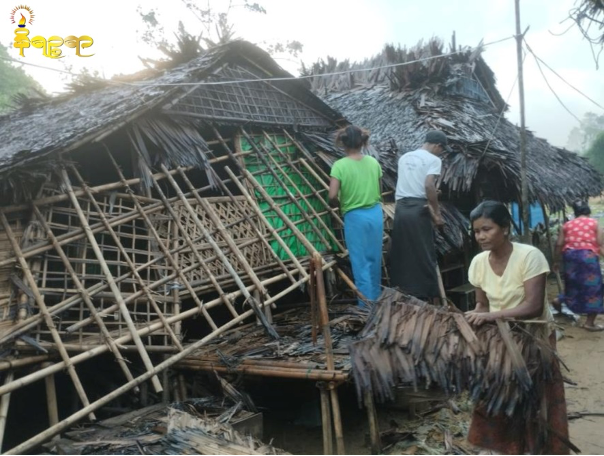
With the onset of the rainy season, mosquito breeding and mosquito bites become rampant. There is a desperate need of mosquito nets for children in the storm-affected areas in the Internally Displaced People (IDP) camps in Arakan State, according to the IDPs.
An in-charge of Tain Nyo IDP camp said: “Now that the rainy season has started. The mosquito breeding rate has increased, and mosquito bites become rampant. I am very concerned that children will get dengue due to mosquito bites. There is a desperate need for mosquito nets.”
Currently, the price of a single mosquito net is 15,000-MMK and a double mosquito net, around 20,000-MMK. So, the IDPs can’t afford to buy mosquito nets, he continued.
Tain Nyo IDP camp has 773 households and 2862 populations. The camp has received only 30 mosquito nets donated by well-wishers from MraukU Township. The mosquito nets have not been distributed to the IDPs due to an unbalanced number of mosquito nets and population, he said.
There may be problems if we can’t distribute mosquito nets sufficiently. So we have to keep it. The mosquito nets donated by other organizations have not yet arrived this year, he said.
Likewise, some IDPs said that there is a danger of mosquito bites in the Mahakangyishin IDP Camp and the Railway Station IDP camp in Kyauktaw as they have not yet received mosquito nets and blankets.
Ko Nyi Nyi Win from the Railway Station IDP Camp said: “Mosquito breeding is rampant. Now that the flu season is here, I’m even worried about getting the flu. Last year, many people were infected with the flu. Until now, we have not received mosquito nets and blankets yet. At present, we can’t afford to buy it. A family needs three mosquito nets. But they have to sleep in a mosquito net.”
There are 321 households and over 2,700 populations at the Railway Station IDP camp. The IDPs have to earn their living by working outside the camp as no donor comes to the camp.
Ma Oo Myint Yee, an IDP from Myolaechaung IDP camp in Rathedaung Township, where 68 households and 274 populations are taking shelter, said: “The International Committee of the Red Cross (ICRC) donated rations twice after the cyclone. There is no one who donates shelters and mosquito nets.
“There are no people who donate shelter, so we have to pick up old pieces of tin for the roof. Water leaks from the roof as it rains. We experience mosquito bites in the evening. The people throw garbage here. We tell the people not to throw garbage. But our efforts have failed. Mosquito bites are rampant. I have to sleep by picking up the old ones,” she said.
Cyclone Mocha destroyed more than 200,000 homes and affected more than one million people, including refugees in Arakan State.
It has been more than one month since the storm hit the Arakan State. But until now, the military council’s effort for the rehabilitation of storm victims is still weak.
Storm victims are facing various difficulties such as livelihood and health as local and foreign donors are banned from helping the people affected by the storm.
Sent by Narinjara