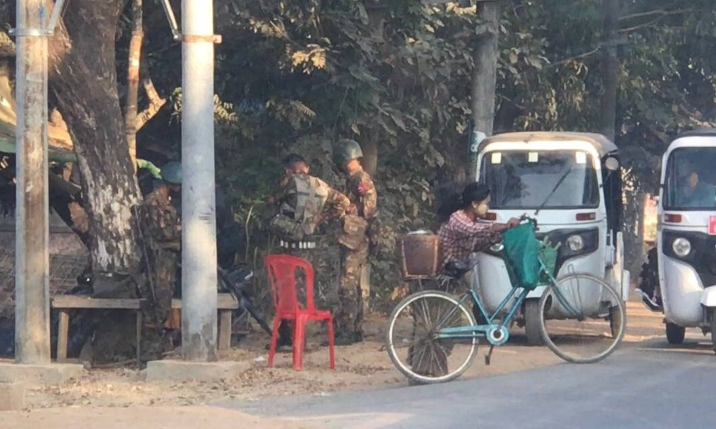
Fighting between military council troops and the Arakan Army (AA) has ceased for more than three months, but the regime is still restricting travel in parts of western state of Myanmar, the United Nations Office for the Coordination of Humanitarian Affairs (UNOCHA) said in a statement.
Access for local and international nongovernmental organizations to urban areas of Maungdaw and Buthidaung Townships remains restricted, and aid workers are still not allowed to travel to most rural areas, UNOCHA said March 4.
In addition, humanitarian aid groups are being checked at military council checkpoints for prolonged time. Although checkpoint time has been reduced from four to two hours this month, humanitarian assistance continues to be impeded, UNOCHA said.
“Due to the lengthy process, we’re experiencing delays in obtaining mandatory travel permits to enter conflict-affected areas throughout the country,” UNOCHA said in the statement.
There used to be only four checkpoints – Angumaw, Inn Taung, Mawrawaddy and 3-Mile – along the Sittwe-Maungdaw Road, but last February the regime established a multi-department checkpoint near 3-Mile, further restricting peoples’ freedom to travel, according to locals.
In Maungdaw and Buthidaung Townships, the flow of goods has been delayed due to the military council’s strict and persistent checks, and the prices of goods have risen sharply, local residents report.
“They check the National Registration Cards (NRCs) at the checkpoints. When they spot suspicious people, they call them over and question them. This annoys people. As for goods, people aren’t allowed to take as much as they need. In our township of Maungdaw, prices have gone up 100 percent, but only dropped 10 percent when they went down again. We’re constantly facing shortages of goods and other materials,” says an education worker from Maungdaw Township.
Currently, the price of a bag of ordinary rice is over MMK 70,000, while a bag of paw san hmwe, a high-grade variety of aromatic rice, can cost up to MMK 150,000.
A resident of Myaung Nar village in Buthidaung Township said that the local population is facing hardship due to the increase in commodity prices and the restricted supply of goods by the military council.
“Also, people from rural areas are only allowed to take a limited amount. So we have a lot of difficulties. It’s not like in the urban areas. In the villages, it’s harder to get medical supplies. When we buy food, they [military council soldiers] don’t allow us to take coffee packets if they think they’re suspicious. We have to get a recommendation from the police for each item,” he says.
In addition, the regime has closed Ponnagyun-Rathedaung Road since June 2022. Although the road was reopened in February 2023, only motorcycles and rickshaws were allowed to travel and no cars, locals say.
The road is important to local people for health, business and education.
“We want this road to be allowed to be traveled as soon as possible because we’re facing general difficulties because of the restrictions. We can’t reach Sittwe directly, but have to transit two or three times. Some drivers became unemployed after the road was closed. I want them to relax the restriction, even if not completely,” said a resident of Pauk Taw Pyin village in Ponnagyun Township.
The DMG called Arakan State Minister of Security and Border Affairs Col. Kyaw Thura, but he couldn’t be reached.
The Myanmar Army and the Arakan Army (AA) had engaged in fierce fighting since August 2022, but a temporary ceasefire was agreed between the two sides on November 26, 2022, on the basis of humanitarianism.
The UNOCHA statement said that despite the progress made through the humanitarian ceasefire, people in Arakan State and southern Chin State are still affected by physical and bureaucratic obstacles.
Sent by DMG.